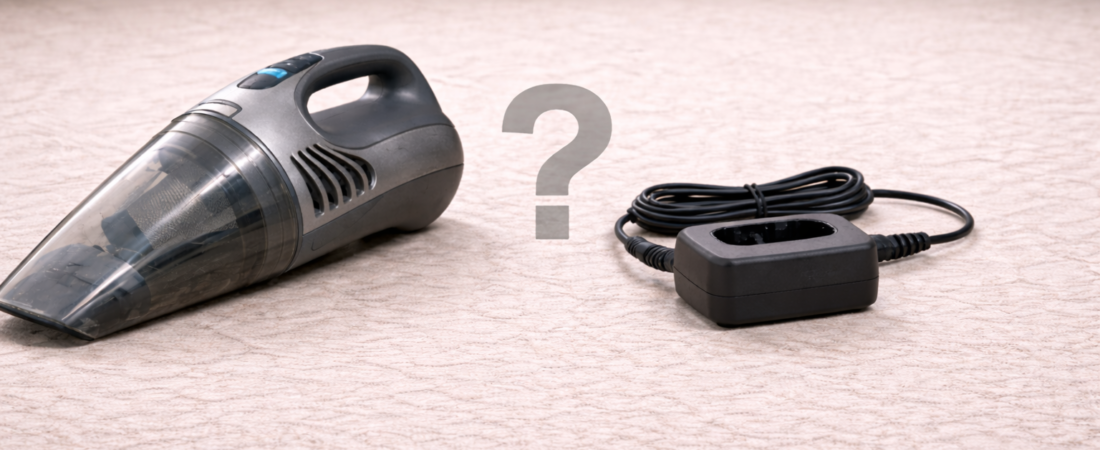
If your vacuum will not charge, the decision usually comes down to one question:
Is the charger the only problem — or is the vacuum reaching the end of its usable life?
Replacing a charger is inexpensive in most cases. Replacing a vacuum is a larger investment. This guide helps you decide.
Step 1: Confirm the Charger Is the Problem
Before replacing anything, check:
• Wall outlet is working
• Charger cable is not visibly damaged
• Charger output voltage matches the original rating
• Charging indicator light behaves normally
If the charger shows no output or obvious failure, replacement is usually reasonable.
For help diagnosing this, see:
👉 Vacuum Charger Not Charging
👉 Vacuum Charger Voltage and Amperage Guide
If voltage cannot be confirmed, do not guess.
Step 2: Check Battery Condition
Even if the charger is faulty, consider the battery condition.
If the vacuum:
• Runs only briefly after charging
• Overheats during use
• Has reduced runtime compared to when new
The battery may already be degraded.
Replacing a charger will not restore battery capacity.
If both charger and battery need replacement, compare the total cost with a new vacuum.
Step 3: Consider the Age of the Vacuum
If your vacuum is:
• Less than 5 years old
• Still providing strong suction
• Mechanically sound
Replacing the charger usually makes sense.
If it is:
• 7–10 years old
• Showing performance decline
• Having multiple issues
A new vacuum may be more practical long term.
Step 4: Compare Replacement Cost
Use a simple rule:
If a replacement charger costs less than 30–40% of the value of a comparable new vacuum, replacement is usually reasonable.
If it approaches half the cost of a new unit, reconsider.
For discontinued models, see:
👉 Replacement Charger for Discontinued Vacuums
Step 5: Confirm Electrical Compatibility
Before purchasing a charger:
✔ Match voltage exactly
✔ Match or exceed amperage
✔ Confirm connector type
✔ Verify polarity
Compatibility errors can damage the battery.
For detailed guidance, see:
👉 Vacuum Charger Compatibility Explained
CTA — When Replacing the Charger Makes Sense
If your vacuum is otherwise functioning well and you have confirmed the correct voltage and connector type, you can view compatible replacement chargers below.
Decision Summary
Replace the charger if:
✔ The vacuum is in good condition
✔ The battery is still healthy
✔ The charger is clearly faulty
✔ Replacement cost is reasonable
Replace the vacuum if:
✖ The battery is degraded
✖ Multiple components are failing
✖ The unit is very old
✖ Combined repair costs approach new unit cost
In most cases, replacing the charger is the simplest and lowest-cost solution — provided the rest of the vacuum is still in good condition.